
CallRail Alternatives in 2026: What I'd Switch To for Rank and Rent Sites, and When I Wouldn't
CallRail pricing at 1, 5 and 20 sites, the four reasons people leave it, and the CallRail alternative that fixes each one. Prices checked October 2026.
On this page
- Is There a Cheaper CallRail Alternative for Rank and Rent?
- What CallRail Does Well
- CallRail Pricing in 2026: What 1, 5 and 20 Sites Actually Cost
- The 4 Reasons People Leave CallRail
- CallRail Alternatives, by Reason
- When I Would Stay on CallRail
- How to Switch Without Losing Calls
- Quick Checklist
- Final Thoughts
- Sources
CallRail is a good product with a bill that grows with every site you add. Here is what it costs at 1, 5 and 20 sites, why people leave, and which alternative fixes each reason. Prices as of October 2026.
Is There a Cheaper CallRail Alternative for Rank and Rent?
I often get asked about CallRail alternatives. Is there something cheaper per number? Will the renter notice the switch? Is it worth moving numbers that already sit in citations?
My view hasn't changed since my call tracking software ranking. I don't need a call center. I need a local number on every site, a recording I can send to the business owner, and a log that proves the site rings.
So, the short answer. For a growing portfolio, CallScaler. For one or two sites, Retreaver. If you write code, Twilio. For pay per call, Ringba, through the network that gives you the account at no charge. And if you run fewer than 5 sites and your renters already log in to CallRail, stay where you are.
The ranking covers seven tools for a fresh buyer. This post starts from CallRail and maps each reason to leave to the tool that fixes it.
What CallRail Does Well
CallRail is the call tracking software most people check first, and it earns that spot. It's built for marketers who want to know which marketing source made the phone ring, and the product feels finished. With one rented site and a renter who wants proof, I would not lose sleep over it.
- A clean UI. You find a call, play the recording and change the forwarding without opening a help article.
- Call recording, routing and transcription on the $50 Lead Tracking plan, with 5 local numbers and 250 local minutes included.
- Scheduled email reports, according to CallRail's support community, which you can point at a renter.
- An integrations directory, and API access on every plan, free up to 1,500 API calls a month.
My problem with CallRail is the price per number, and only once the site count grows.
CallRail Pricing in 2026: What 1, 5 and 20 Sites Actually Cost
As of October 2026, CallRail's Lead Tracking plan starts at $50 a month plus usage, with 5 local numbers, 250 local minutes and 25 texts included. Each extra local number is $3 a month. Yearly billing saves up to 10%, and a footnote on the pricing page shows Lead Tracking at $55, so the $50 may be the yearly price. I use $50 below.
One number per site, before minutes:
| Sites | Numbers needed | CallRail monthly | Cheapest alternative monthly |
|---|---|---|---|
| 1 | 1 | $50 | $1 (Retreaver) |
| 5 | 5 | $50 | $5 (Retreaver) |
| 20 | 20 | $95 | $20 (Retreaver) |
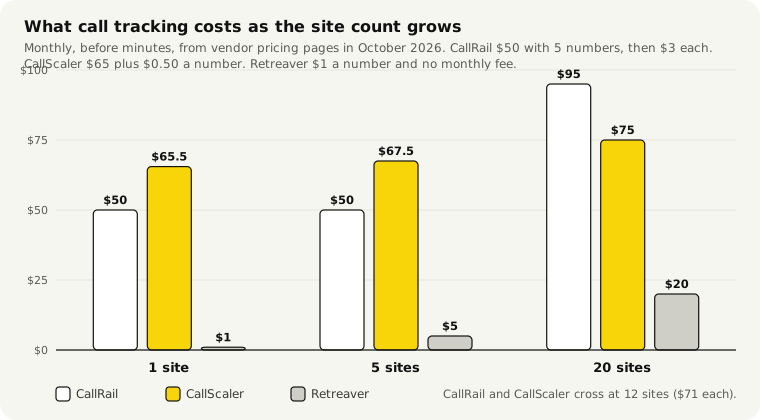
CallRail at 20 sites is $50 plus 15 extra numbers at $3. Retreaver has no platform fee and charges $1 a number, so it's the cheapest at every size.
CallScaler, my pick for a real portfolio, is $65 a month billed yearly plus $0.50 a number. That makes it $65.50 for 1 site, $67.50 for 5 and $75 for 20. So CallRail stays cheaper than my own pick up to 11 sites. The two meet at 12 sites, $71 each, and every site after that widens the gap by $2.50.
One thing narrows the gap: CallRail's $50 includes 250 local minutes, while the alternatives bill minutes from the first call. One thing widens it: CallRail rounds every call up to the nearest minute.
The price hurts on unrented sites. A rented site in our target range brings $500 to $1,000 a month, so $3 a number never kills a deal on its own. Individual results vary. But 15 unrented sites at $3 is $45 a month for sites that earn nothing yet.
The 4 Reasons People Leave CallRail
1. You Pay $3 a Number for Sites That Earn Nothing
Rank and rent means building first and renting later. Some sites rent in a month, some take longer, and some never rent. At $3 a number after the first 5, CallRail charges the most for the sites that bring in the least. At 20 sites, most of that bill pays for waiting.
The alternative that fixes this: CallScaler.
2. You Pay for Marketing Attribution You Don't Use
CallRail tracks calls and texts back to marketing sources, and its higher plans add form tracking, multi-touch cost per lead reporting and conversation intelligence. An agency running ads needs that. A rank and rent site has one number and one job: prove the phone rang.
The alternative that fixes this: Retreaver.
3. The Renter Wants Their Own Login
A scheduled email works for most renters. Some want to log in, scroll the call log and play recordings themselves. I don't want a renter anywhere near the account that holds my other sites, so I want a renter view that shows their calls and nothing else.
The alternative that fixes this: CallScaler, with its client portal.
4. You Need Pay Per Call Routing
CallRail sends a call to a phone. Pay per call sends a call to a buyer, often through ring trees and bids, and gets paid per qualified call. That needs a different kind of call tracking software.
The alternative that fixes this: Ringba, through your pay per call network.
CallRail Alternatives, by Reason

Every price below comes from the vendor's own pricing page, checked in October 2026.
CallScaler
CallScaler fixes reasons 1 and 3. The Call Tracking plan is $65 a month billed yearly, plus usage. Local numbers are $0.50 a month, local minutes $0.045 and call recording $0.005 a minute. There is a 14-day trial and a 30-day money-back guarantee.
What you gain over CallRail: call tracking numbers at a sixth of the price. At 20 sites you pay $75 instead of $95, and each new site adds 50 cents. You also get a client portal, where the renter logs in to see calls and play recordings with the permissions you set.
What you lose: the plan covers 3 businesses with 5 users. Put renter number 4 in their own workspace and you need the unlimited businesses add-on at $95 a month. Up to 11 sites, CallRail's total is lower. And if you leave later, porting a number out costs $10.
Move to CallScaler when you're past 5 sites and still building. The totals cross at 12, and every site after that costs you less.
Retreaver
Retreaver fixes reason 2. It has no monthly platform fee and no contract. Numbers are $1 a month each, and call minutes start at $0.05.
What you gain over CallRail: a site costs $1 a month plus its minutes, and you stop paying for an attribution suite. Five sites cost $5 instead of $50. Retreaver also gives call buyers their own logins. A renter is a call buyer, so that covers the renter view.
What you lose: polish. Retreaver comes from the pay per call world, and the dashboard talks about campaigns, buyers and publishers. A renter used to CallRail's call log may need a walkthrough. The pricing guide also doesn't list a rate for call recording, so check your first invoice before you move every site.
The cheapest way off CallRail for a small portfolio, if a buyer-style dashboard doesn't bother you.
CallRail vs WhatConverts
WhatConverts tracks calls, forms and chats. The Call Tracking plan is $30 a month and includes a $30 usage credit. Extra local numbers are $2.50 each, and call recording is included.
What you gain over CallRail: a lower entry price, unlimited users, and 50 cents less per extra number.
What you lose: easy scheduled reports. According to CallRail's support community, CallRail can email them. On WhatConverts, they sit on Pro at $100 a month. One WhatConverts account also tracks one business, so you keep every site in one account or pay $500 a month for unlimited accounts.
I would only make this move if you also track forms and chats for clients.
A sideways move for rank and rent. Pick WhatConverts for reports and form tracking, not to cut the cost per site.
CallRail vs CallTrackingMetrics
CallTrackingMetrics, now branded CTM, is call tracking plus a contact center. Marketing Lite is $79 a month, or $65 a month billed yearly, plus usage, with $0 plan fees for the first month. Marketing Pro is $179 monthly or $149 yearly.
What you gain over CallRail: unlimited users on Marketing Lite, with recording, forwarding and IVR routing. Marketing Pro adds 25 sub-accounts and white label options, which gives every renter their own space.
What you lose: a known price per number. The pricing page I checked showed no rate for US local numbers, so I can't do the 20-site math for CTM, and that alone stops me. The product also leans into softphones, dialers and VoiceAI, which a rank and rent site never touches.
Worth a look for an agency that also runs ads. For a rank and rent portfolio, it costs more than CallRail and tells you less up front.
Twilio
Twilio sells the raw parts. A US local number is $1.15 a month, receiving a call is $0.0085 a minute, and recording is $0.0025 a minute. There is no plan fee. At 20 sites, that is $23 a month before minutes.
What you gain over CallRail: the lowest cost per number and per minute, and full control through the API. A forwarding swap can be one line in a script.
What you lose: everything CallRail gives you out of the box. There is no call log a renter can read and no recordings page until you build them. Forwarding a call to the renter also means a second, outbound minute at $0.014, so each forwarded call is billed twice.
Pick Twilio only if you code. Otherwise, CallRail's $3 buys you a product that Twilio leaves you to build.
Ringba (and When the Network Pays for It)
Ringba is built for pay per call. Business is $147 a month, or $127 a month billed annually. Local numbers are $3 a month and recording is $0.01 a minute.
What you gain over CallRail: routing to buyers, ring trees and publisher access to recordings.
What you lose on rank and rent: money. At 20 sites, Ringba is $187 a month before minutes, against $95 on CallRail, for routing one renter per site never uses.
On pay per call, you likely don't buy it at all. LeadSmart gives its publishers a Ringba account with numbers and recordings at no charge. My guide to pay per call affiliate networks covers the networks I trust. Pay per call earned $8 to $88 per site per month in our data. Individual results vary. Compare the models in rank and rent vs pay per call, or see my pay per call setup.
On pay per call sites, take the network's Ringba account and drop CallRail. On rank and rent, Ringba costs more than what you are leaving.
When I Would Stay on CallRail
If you run fewer than 5 sites, CallRail's $50 covers every number plus 250 minutes. At 5 sites, the cheapest alternative saves you $45 a month before minutes, and you give part of that back once calls come in. That is not worth moving numbers that already sit in citations.
I would also stay if your renters already log in to CallRail, or if you lean on its reports every month. A renter who suddenly sees a new dashboard asks questions. If any of that fits, keep CallRail and spend the time building the next site.
How to Switch Without Losing Calls
The risk in any switch is a call that rings a dead number. This is the order I would follow:
- Keep the CallRail numbers live for 60 days. They sit in your citations and the Google Business Profile.
- Buy the new local numbers, one per site, in the city's area code.
- Update the site. On Local Sites Pro, the phone number you enter feeds every call button and phone link on every page, so you swap the number in the dashboard and publish. More on how I run rank and rent sites.
- Update citations and GBP. My local citations guide covers where those listings live.
- Forward the old numbers to the new ones. A caller who finds an old listing still reaches the renter, and the new tracker logs the call. You pay minutes on both tools for those 60 days.
- Then port or cancel. Port a number that is listed in a lot of places. Cancel one that only lived on the site.
Tell each renter before step 3, so the new report doesn't surprise them.
Quick Checklist
Final Thoughts
CallRail does the job well. The bill is the problem: $3 a number on a portfolio where most sites still wait for a renter.
So, I would move a growing portfolio to CallScaler, start a tiny one on Retreaver, use the network's Ringba account for pay per call, and leave a small portfolio with happy renters where it is. New to the model? Read what rank and rent is, or see Local Sites Pro pricing for the sites themselves.
Leave CallRail when you pass 5 sites and most of them aren't rented. Until then, it's money well spent.
Sources
- CallRail: https://www.callrail.com/pricing, October 6, 2026
- CallScaler: https://www.callscaler.com/pricing, October 6, 2026
- Retreaver: https://learn.retreaver.com/guides/pricing, October 6, 2026
- WhatConverts: https://www.whatconverts.com/pricing/, October 6, 2026
- CallTrackingMetrics: https://www.ctm.com/plans-pricing/, October 6, 2026
- Twilio: https://www.twilio.com/en-us/voice/pricing/us, October 6, 2026
- Ringba: https://www.ringba.com/pricing, October 6, 2026
Comments
Or discuss it in the Skool communityNo comments yet. Ask a question or share what you tried, and I will reply here.